Castellano
Adam Gilley habla de Retaliate, del legado de Shaun Glass y del futuro del grupo
El 1 de julio de 2026, la muerte de Shaun Glass dejó a Repentance ante una situación que iba mucho más allá del lanzamiento de un nuevo disco. La banda de Chicago decidió aplazar la publicación de Retaliate, un trabajo que finalmente verá la luz el 27 de noviembre a través de Noble Demon. Sus canciones conservan la contundencia del groove y el thrash metal que define al grupo, pero ahora también están inevitablemente ligadas al recuerdo de su fundador. Conversamos con el vocalista Adam Gilley sobre la composición del álbum, el trabajo de producción y la manera en que el significado de algunas canciones ha cambiado tras la pérdida de Shaun. Su relato también permite comprender qué quiere preservar Repentance de la identidad que construyeron juntos y cómo afrontan la próxima etapa.
Entrevista: Jose Cardona
Entre The Process of Human Demise y Retaliate, ¿qué cambió más en la manera en que Repentance construye sus canciones? ¿Había algún aspecto del sonido o de la composición que quisierais llevar más lejos, en lugar de limitaros a repetir lo que ya había funcionado?
Shaun siempre llegaba con un riff, y eso marcaba el tono y la dirección de la canción. No teníamos una manera concreta de hacerlo. Queríamos que las canciones siguieran sonando a nosotros, pero sin resultar repetitivas. Siempre buscamos ese gancho que se queda contigo. Eso siempre ha sido importante para nosotros.
Te incorporaste a Repentance en la etapa de Volume I Reborn y desarrollaste aún más tu papel en The Process of Human Demise. Mirando atrás, ¿cómo había evolucionado tu relación creativa con Shaun Glass y con el resto de la banda durante la composición de Retaliate, especialmente a la hora de decidir cómo debía interactuar una línea vocal con los riffs?
Cuando empezamos a componer Retaliate, llevábamos unos cinco años tocando juntos. Todos empezamos a entender qué funcionaba y qué no. Además, todo el mundo está muy abierto a las ideas y a probar formas nuevas de hacer las cosas. Es fantástico estar en una banda en la que no hay egos. En cuanto a cómo interactúan una línea vocal y un riff, para Shaun y para mí eso siempre fue nuestra especialidad. Desde el primer día, sus riffs hacían que escribir líneas vocales resultara divertido y sencillo.
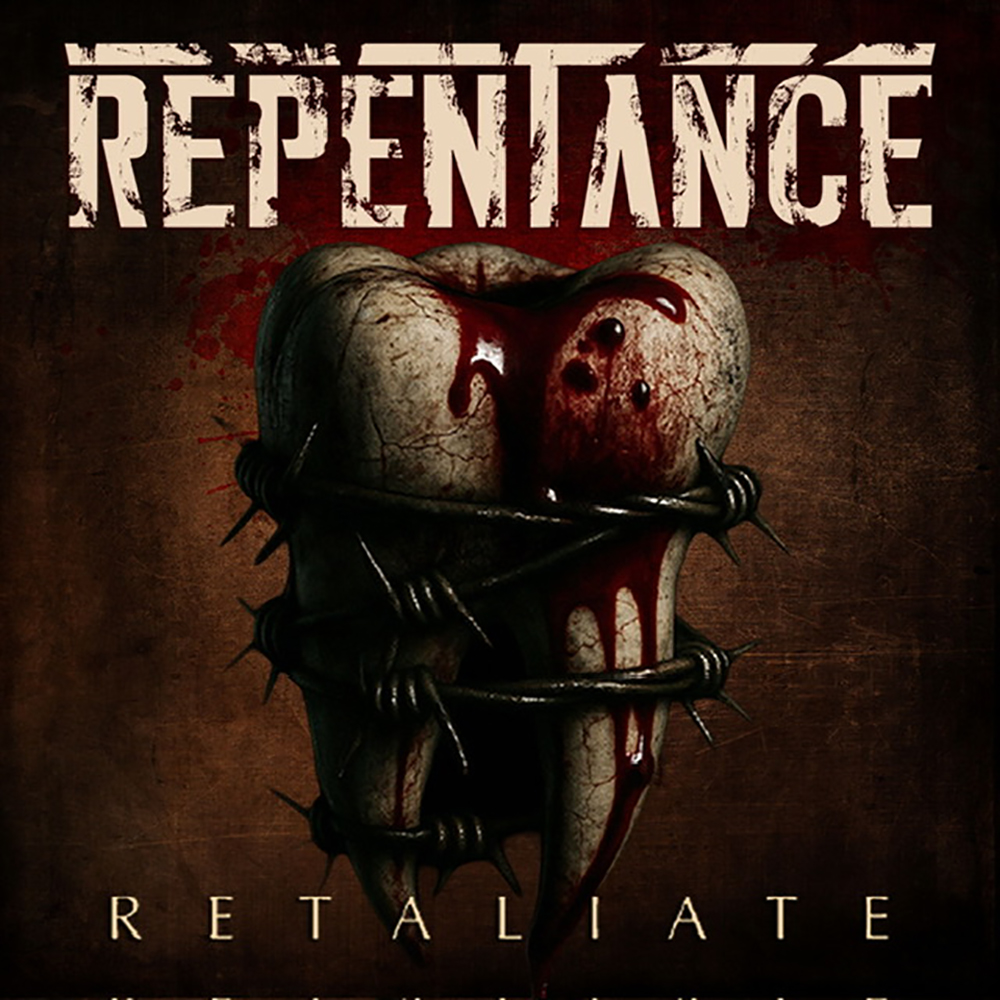
Presentaste la canción que da título al disco como una declaración directa y agresiva, pero buena parte de su atractivo reside también en sus estribillos memorables. ¿Cómo tomó forma «Retaliate» y qué decisiones de arreglo os ayudaron a mantener su impacto inmediato sin convertir la velocidad y la agresividad en fines en sí mismos?
Retaliate fue tomando forma canción a canción. En cuanto a la secuencia del álbum, supongo que todo depende de cómo termina un tema y cómo comienza el siguiente. Queríamos mantener un buen equilibrio entre las canciones. El objetivo siempre es dejar al oyente con ganas de más.
El disco comienza con «From Violence To Silence» y termina con «Blood Of The Earth», dos títulos que sugieren imágenes muy diferentes. ¿Fueron las diez canciones revelando poco a poco un hilo lírico o emocional común, o el orden del álbum respondió principalmente al recorrido musical que queríais ofrecer al oyente?
Diría que dependió más del viaje musical que queríamos que experimentara el público. La canción de apertura es la calma antes de la tormenta, mientras que la última representa más bien lo que queda después. Las consecuencias de todo lo ocurrido.
Has descrito «Among The Wolves» como una canción sobre la traición, la rabia y la desilusión que deja alguien que causa un dolor emocional profundo. ¿Cómo se trasladó esa experiencia a la letra y de qué manera utilizaste el fraseo vocal y los cambios rítmicos para expresar algo más complejo que la ira?
El tema de todo el álbum es la represalia. Por eso utilicé experiencias pasadas o presentes de aquel momento como munición para el disco. Cuando escribo, dejo que la música me guíe. Cada parte de una canción me provoca una emoción. Puede ser como un camión que se te viene encima a cien millas por hora o como un lago que parece tranquilo en la superficie, pero que debajo es muy oscuro e inquietante. Dejo que la música me lleve en una u otra dirección. Eso es lo que me ayuda a dar forma a mis partes.
Alex Lackner produjo Retaliate en Accelerated Sound, mientras que Ari Mihalopoulos se encargó de la mezcla. ¿Qué queríais que captara la producción del sonido físico y marcado por el groove de la banda? ¿Cómo buscasteis el equilibrio entre la precisión del metal moderno y la tensión cruda de unos músicos tocando juntos?
Alex y yo crecimos juntos. Tiene un gran oído para la música y siempre he respetado sus ideas y opiniones. Sé que Shaun estaría de acuerdo. Alex, Shaun y yo éramos uña y carne. Consideramos a Alex otro miembro de la banda. En cuanto a Ari, sabíamos que nos ayudaría con la dinámica y a conseguir un sonido diferente al del álbum anterior. Así habría cierta separación entre los dos discos sin perder ese sonido de Repentance.
Con Shaun Glass y Eric Burns aportando ambos guitarras, ¿cómo influyó la interacción entre sus partes en los arreglos? ¿Puedes señalar algún momento del disco en el que una parte de guitarra cambiara el carácter de una canción, en lugar de limitarse a añadir otra capa de contundencia?
No sabría explicarte cómo sus partes y los arreglos moldearon las canciones, pero, cuando pienso en un tema que cambia de carácter, hay uno que me viene especialmente a la cabeza: «What’s Done Is Done».
«Fade Into Silence» fue escrita por Shaun y posteriormente elegida como sencillo dedicado a su memoria. ¿Qué recuerdas de cómo nació la canción y de qué manera ha cambiado su significado para ti desde que la banda decidió compartirla como homenaje?
Uf, bueno. Cuando empezó a tomar forma y escuché el estribillo, inmediatamente pensé en utilizar voces limpias. Me preocupaba lo que pudieran pensar Shaun y los demás, pero, cuando la escucharon, dijeron que probablemente sería la favorita de los fans. Para mí fue un alivio inmediato, porque no suelo cantar de esa manera. La idea original de la canción era estar atrapado en medio de dos grandes amigos que estaban rompiendo su relación. Sin embargo, ahora, cuando la escucho, pienso en Shaun. Curiosamente, gran parte de la letra expresa cómo me siento al perder a un amigo cercano. Así que, supongo, terminó encajando de una manera muy especial.
El legado de Shaun se extiende a varias décadas de metal en Chicago, pero su trabajo en Repentance también estuvo marcado por las decisiones cotidianas en los ensayos y en el estudio. ¿Qué detalle de su manera de abordar la música o de trabajar con la banda, quizá desconocido para los oyentes, te gustaría que se recordara?
Shaun siempre decía que todo estaba en encontrar ese gancho. Me aconsejaba pensar en la música pop cuando escribía. Y, por cierto, era un gran aficionado al pop. Creo que por eso sus riffs siempre tenían tanto gancho y tanto groove. Me gustaría que se le recordara por su sonido y su estilo únicos.
Tras la muerte de Shaun, la banda aplazó Retaliate respecto a su fecha original de verano. Más allá del cambio de calendario, ¿alteró lo sucedido la manera en que queríais presentar el álbum o cómo habláis ahora de estas canciones?
Sí, la experiencia cambió por completo. Quiero que este álbum se presente de la mejor manera posible. Aunque ahora que él ya no está, siento que, por muy bien que lo presentemos, nunca será tan grande como podría haberlo sido si siguiera aquí. Eso hace que deseemos más que nunca que el álbum llegue a mucha más gente. Shaun estaba muy entusiasmado con este disco. Incluso llegó a decir que quizá contenía parte de la mejor música que había escrito.
Estas canciones tendrán otra vida cuando lleguen al escenario. Cuando toque interpretar Retaliate en directo, ¿qué esperas que el público escuche y sienta? ¿Cómo te gustaría que la aportación de Shaun siguiera presente sin que cada actuación quedara definida únicamente por su ausencia?
Cuando subamos al escenario, espero que los fans sigan escuchando a Shaun y sintiendo su presencia. Creo que los primeros conciertos podrían parecer marcados por la pérdida, pero puedo asegurarte que no será así. Cada actuación será siempre una dedicatoria para él, y sé que, de alguna manera, estará allí arriba con nosotros cada vez que salgamos a tocar.
Mirando más allá de este lanzamiento, ¿qué elementos de la identidad de Repentance, construida con Shaun desde el principio, consideras esenciales preservar? Y, al mismo tiempo, ¿en qué aspectos crees que la banda necesitará libertad para crecer y encontrar su propio camino?
Tenemos que preservar su sonido lo mejor posible, y también la estructura de las canciones. Cuando estábamos componiendo, Shaun siempre decía que, si algo sonaba a Repentance, entonces teníamos una canción. Si no sonaba a Repentance, no lo era. Así que ahora siento que tenemos que esforzarnos de verdad para que Shaun se sienta orgulloso de nosotros. Va a ser difícil, pero sé que podremos hacerlo. Todo lo que haga esta banda será, de ahora en adelante, en su honor.
English
Repentance: «Everything this band does is always in his honor»
Adam Gilley discusses Retaliate, Shaun Glass’s legacy and the band’s future
On July 1, 2026, the death of Shaun Glass left Repentance facing circumstances that went far beyond the release of a new record. The Chicago band decided to postpone Retaliate, an album now set to arrive on November 27 through Noble Demon. Its songs retain the forceful groove metal and thrash that define the group, but they are now inevitably bound to the memory of its founder. We spoke with vocalist Adam Gilley about writing the album, the production process, and how the meaning of some songs has changed following Shaun’s passing. His account also sheds light on which elements of the identity they built together Repentance want to preserve and how they face the next chapter.
Interview: Jose Cardona
Between The Process of Human Demise and Retaliate, what changed most in the way Repentance build a song? Was there a particular aspect of your sound or songwriting that you wanted to push further rather than simply repeat what had worked before?
Shaun always came in with a riff, and that would set the tone and direction of the song. There really wasn’t one particular way of doing things. We wanted the songs to still sound like us, but without being repetitive. We’re always pushing for that hook. That’s always been important to us.
You joined Repentance for Volume I – Reborn and developed your role further on The Process of Human Demise. Looking back at the writing of Retaliate, how had your creative relationship with Shaun Glass and the rest of the band evolved, particularly when deciding how a vocal line should interact with the riffs?
Looking back at the writing of Retaliate, by then we’d all been playing together for about five years. We all started to see what worked and what didn’t. Everyone is very open-minded about ideas and trying new approaches. It’s great when you’re in a band with no egos. As for a vocal line and a riff interacting, well, for Shaun and me that was always our bread and butter. He had riffs that made it fun and easy to write vocal lines to, right from day one.
You introduced the title track as a direct, aggressive statement, but its appeal also depends on memorable hooks. How did «Retaliate» take shape, and what did you do in the arrangement to keep its impact immediate without letting speed and aggression become ends in themselves?
Retaliate took shape one song at a time. As for the arrangement, I suppose it’s all about how one song ends and the next begins. We wanted to keep a good balance between tracks. The goal is always to keep the listener wanting more.
The record opens with «From Violence To Silence» and ends with «Blood Of The Earth», two titles that suggest very different images. Did the ten songs gradually reveal a common lyrical or emotional thread, or was the album sequence primarily determined by the musical journey you wanted listeners to experience?
I’d have to say it was more determined by the musical journey we wanted listeners to experience. The opening track is the calm before the storm, and the last track is more the aftermath: what’s left at the end.
You have described «Among The Wolves» as a song about betrayal, anger and disillusionment after someone causes deep emotional pain. How did that experience find its way into the lyrics, and how did you use vocal phrasing and the song’s rhythmic changes to express something more complex than anger alone?
Well, the whole album’s theme is retaliation. So I took past and present experiences at the time and used them as ammunition for the record. I let the music guide me when I’m writing. Each part of a song gives me an emotion. That emotion might be a Mack truck coming at you at a hundred miles an hour, or a lake that’s calm on the surface but very dark and haunting beneath. I let the music take me in either direction. That’s what helps me shape my parts.
Alex Lackner produced Retaliate at Accelerated Sound, while Ari Mihalopoulos handled the mix. What did you want the production to capture about the band’s physical, groove-driven sound, and how did you approach the balance between precise modern metal and the raw tension of musicians playing together?
Alex and I grew up together. He’s got a great ear for music. I always respected his thoughts and opinions, and I know Shaun would agree. Alex, Shaun and I were as thick as thieves. We view Alex as another member of the band. As for Ari, we knew he would help with the dynamics and give us a different sound from the previous album. That way there would be some separation between both albums while still keeping that Repentance sound.
With Shaun Glass and Eric Burns both contributing guitars, how did the interaction between their parts shape the arrangements? Can you point to a moment on the album when a guitar part changed the character of a song rather than simply adding another layer of heaviness?
I couldn’t really tell you how their parts and the arrangements shaped the song, but one song in particular comes to mind when it comes to changing character, and that’s «What’s Done Is Done».
«Fade Into Silence» was written by Shaun and later chosen as a single dedicated to his memory. What do you remember about how that song first came together, and how has its meaning changed for you since the band decided to share it as a tribute?
Oh boy, okay. When that song first came together, I heard the chorus and my mind went to clean vocals. I was worried what Shaun or the rest would think, but when they heard it, they said it would most likely be the fan favorite. Instant relief on my end, as I don’t sing like that much. The song’s original meaning was about being caught in the middle of two great friends cutting ties with each other, but now when I hear it, I think of Shaun. Oddly enough, most of the lyrics express how I feel about losing a close friend. So it seemed quite fitting, I suppose.
Shaun’s legacy stretches across several decades of Chicago metal, but his work within Repentance was also shaped by everyday decisions in rehearsals and recording sessions. What is one detail about the way he approached music or worked with the band that listeners might never have seen, but that you feel deserves to be remembered?
When it came to Shaun, he would always say it was all about the hook. He would tell me to think of pop music when writing. By the way, he was a huge fan of pop, which is why I think he always had such catchy and groovy riffs. I’d like him to be remembered for his unique sound and style.
After Shaun’s passing, the band postponed Retaliate from its original summer release date. Beyond the change in the calendar, did the experience alter the way you wanted the album to be presented or the way you speak about these songs now?
Yeah, the experience definitely changed. I want this album to be presented in the best possible way. Although now that he’s no longer here, I feel that no matter how well it’s presented, it will not be as great as it could have been if he were still here. It makes us want that album to reach more ears than ever. Shaun was very excited about this album. He even went so far as to say it might be some of the best music he’d ever written.
These songs will eventually have a different life when they are performed in front of an audience. When the time comes to bring Retaliate to the stage, what do you hope people will hear and feel in the music, and how would you like Shaun’s contribution to remain present without every performance being defined only by loss?
When we hit that stage, I hope the fans will still hear Shaun and feel his presence. I feel the first couple of shows may seem like performances defined by loss, but I can assure you they won’t be. Every show will always be a dedication to him, and I know he’ll be up there with us in some way every time we hit that stage.
Looking beyond this release, which elements of Repentance‘s identity, built with Shaun from the beginning, feel essential to preserve? At the same time, where do you believe the band will need the freedom to grow and find its own way forward?
We’ve got to preserve his sound as best we can, and the structure. Shaun always said when we were writing, if it sounds like Repentance, then we’ve got a song. If it doesn’t, then it’s not Repentance. So I feel we’ve really got to step it up now to make Shaun proud from here on out. It’s going to be tough, but I know we can handle it. Everything this band does is always in his honor from now on.