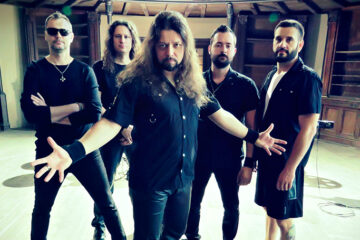
Nervosa parece haber estabilizado su carrera a punto de editar su sexto álbum, Slave Machine. Con la guitarrista y fundadora Prika Amaral consolidada como su nueva cantante desde su anterior disco, Jailbreak, han vuelto a trabajar una vez más con el productor Martin Furia, tendiendo un puente entre el poder de la vieja escuela y la modernidad. Nos ponemos en contacto con la misma Prika y la guitarrista Helena para conversar del nuevo trabajo.
Castellano
Empecemos por el título, «Slave Machine»; quizá sugiera una crítica mordaz a la deshumanización actual… ¿Es este el álbum más político y social de la historia de Nervosa o tal vez estoy dándole demasiadas vueltas al asunto?
PRIKA: Es muy difícil decir que sea lo más político, porque Nervosa siempre se ha interesado por la política y esas cosas. Pero en este caso, creo que estamos hablando de un problema muy actual, ya sabes, por el que todo el mundo está pasando. Y es algo con lo que toda la humanidad estamos intentando averiguar cómo lidiar.
Por ejemplo, la IA es algo nuevo y no sabemos hasta qué punto es buena, aunque sabemos muy bien cuándo es mala. Pero creo que todavía estamos averiguando cuáles son sus límites, porque la IA está llegando a un nivel que confunde a la gente entre la realidad y la fantasía. Pero, por otro lado, todas estas tecnologías están ayudando a encontrar nuevos recursos para los antibióticos por ejemplo.
Hay cosas buenas ahí y todo es algo muy nuevo para todos nosotros. Queremos plantear esta conversación porque creemos que está resultando muy tóxico, sobre todo para la nueva generación, porque nosotros ya tenemos nuestra personalidad formada. Llegó Internet, hay cierta toxicidad hasta cierto punto, pero la generación más joven no sabe quiénes son. Y hay tanta información y tantas cosas que se están perdiendo en sus vidas. Y eso es muy peligroso, porque ¿cómo va a ser entonces el futuro?
Así que es algo que queremos sacar a colación para debatir, para criticar, porque en realidad todo el mundo está de acuerdo con eso. Nadie está completamente feliz. No, yo estoy feliz con todo. Es imposible. Conozco a mucha gente que tiene hijos con trastornos alimentarios, ya sabes, como anorexia, bulimia, y todo el mundo empieza a hacerse cirugía plástica a una edad muy temprana. ¿Qué coño está pasando? Y todo el sistema, el sistema de la máquina esclavista, está afectando a todos de alguna manera.
Sí, estoy de acuerdo. No sé si pensáis lo mismo, pero creo que «Jailbreak» fue un álbum muy bien recibido por la prensa y por los fans en general. Teniendo en cuenta esa opinión de los fans y la prensa, ¿quizás para este nuevo álbum hubo algún límite que no quisisteis traspasar a la hora de componerlo? Porque a mí me suena un poco diferente en varios aspectos. Por ejemplo, las voces, de las que podemos hablar un poco más adelante.
PRIKA: Sí, siempre, en todos los álbumes en los que he participado con esta banda, nunca he querido poner barreras ni límites, porque creo firmemente que la inspiración tiene que ser libre. Ya sabes, no se puede bloquear la inspiración. Hay que dejarla fluir y dejarse llevar. Y las puertas siempre han estado abiertas para que todo el mundo pudiera aportar su granito de arena. Algunas personas no estaban disponibles, otras no tenían tanta inspiración para participar o lo que fuera, diferentes motivos, problemas, muchas cosas de por medio.
Pero para este álbum, Helena y yo somos las compositoras principales y estuvimos hablando de exactamente lo que a Helena le gustaría aportar a este nuevo álbum. Yo pensaba en explorar más melodías, porque es el segundo álbum en el que Nervosa cuenta con dos guitarristas. Así que había muchísimas posibilidades abiertas.
Y ahora, hablando también de las voces para este álbum, pude hacerlo aún más, porque ahora soy realmente cantante. En su día, en «Jailbreak», fui cantante durante dos meses. Apenas tenía músculos en la garganta y no estaba segura de si sería capaz de tocar y cantar. Pero después de estar de gira todos estos años, ahora tengo músculos suficientes. Sé lo que puedo hacer. He tenido tiempo para estudiar cosas nuevas. Por eso hemos podido hacer más. Y por eso el álbum también es tan diferente. Y Micaela, como baterista, ha podido aportar más de sus influencias a la banda, porque la nueva composición se acerca más a lo que realmente le gusta.
HELENA: Sí, en general, no teníamos límites ni restricciones. Nos dejamos llevar por la corriente. Hablamos antes y tuvimos muchas conversaciones y sesiones de brainstorming sobre cómo veíamos el nuevo álbum, hablando musicalmente del ambiente, la temática y todo eso. Hablamos mucho antes.
Pero, de nuevo, tuvimos una especie de sintonía instantánea de ideas. Eso también lo tuvimos en Jailbreak. Pero además, después de estos tres años de gira por todas partes y de hablar, nos conocíamos cada vez más, fue más fácil y nos sentíamos más abiertas y más seguras para hacer este nuevo álbum. Porque en Jailbreak trabajaba el mismo equipo, pero era como si fuera la primera vez que trabajábamos todas juntas.
Y con Micaela, por aquel entonces, acabábamos de conocernos y, para mí, era la primera vez en el estudio con Nervosa y Martin Furia, el productor. Así que esta vez estábamos más relajados, nos conocíamos y teníamos más claro, ya sabes, lo que queríamos y cómo podíamos lograrlo. Pero nunca nos ponemos límites, exactamente, antes de embarcarnos en estos álbumes y evolucionar.

Mencionamos la voz… es uno de los aspectos que me llama la atención… No sé cómo definirlo exactamente. Pero quizá esa sea la palabra: un poco más trabajada, con más trabajo en el estudio.
PRIKA: Sí, la cuestión es que, cuando grabamos Jailbreak, no sabía qué hacer y estaba muy asustada, porque no sabía si los fans lo aceptarían, si sería lo suficientemente bueno y todas esas cosas.
Y después de que todo saliera a la luz, hicimos muchas giras y todo salió muy bien. A los fans les encantó, seguimos trabajando y crecimos como banda. Yo también pude crecer como cantante. Tenía mucho tiempo. Así que me sentía súper segura con este nuevo álbum.
Sabía exactamente qué quería ser como cantante, qué quería hacer y veía las diferentes voces. Seguro que todavía me queda mucho por aprender, pero cada vez que se abre un camino tengo más cosas que aportar y en el estudio lo probábamos absolutamente todo.
En un momento dado, a la hora de trabajar dije: «Veamos qué voces vamos a dejar». Y ellos me dicen: «Mírame, dejémoslas todas». Así fue, Martin tiene un montón de buenas ideas como productor y creo que esa es la magia que crea. Cogió algo que hicimos, que construimos, y lo hizo más grande, suena bien, suena más grande. Es el rey de la masterización y la mezcla, y también de la producción. Por eso seguimos insistiendo en trabajar con él, porque coge nuestro trabajo y lo mejora.
Esa es una de las cosas que también me gustaría comentar: el trabajo con Martin, porque supongo que sigues creyendo que contribuye a que vuestro sonido evolucione un más.
PRIKA: Exacto, exacto, porque respeta lo que es la banda y todo lo que construimos. Y la cuestión es que sabe cómo sacarnos el máximo partido, cómo exprimirnos, cómo sacar todo lo que podemos dar, pero de una forma positiva, no negativa. Y eso es increíble, es justo lo que queríamos con este nuevo álbum.
Queríamos crear algo diferente, porque no queremos repetir todo lo que hicimos con Jailbreak, ya que cuando vamos a los conciertos, vamos a tocar muchas canciones de Jailbreak, pero queremos tocar cosas diferentes, no queremos repetir lo mismo que ya se hizo. Así que ese era el objetivo para nosotros: sorprender a los fans y también que nosotros disfrutemos estando en el escenario y tocando canciones diferentes.
En cuanto a la música, ¿hay algún tema en este álbum que consideres un poco arriesgado o que se aleje de lo que los fans suelen esperar de Nervosa?
PRIKA: Siempre se puede decepcionar a la gente, porque no se puede conseguir que todo el mundo ame lo que haces constantemente, ya sabes. Lo importante es mantener las raíces del grupo, pero al mismo tiempo ser libres para crear; si a los fans no les gusta, pueden saltarse la canción. Es muy fácil. Así que no nos preocupa ese aspecto. Por supuesto, queremos crecer como banda, queremos más fans, y hacemos música para nuestros fans, pero también la hacemos para nosotros mismos; son las dos cosas, como si siempre intentáramos encontrar un punto en el que podamos encontrarnos y ser felices.
Ya que tengo la oportunidad de charlar con las dos guitarristas del grupo, y hablando sobre guitarras y vuestro equipo. ¿Habéis cambiado algo en vuestro equipo para este disco? Hoy en día hay muchas opciones, vosotras lo sabéis mejor que yo.
PRIKA: No hay ni un solo guitarrista en el mundo que esté contento con su equipo. Podemos estar contentas durante meses, pero luego empezamos a cambiar cosas y a probar, y eso nunca se acaba.
HELENA: Sí, hemos estado trabajando en el sonido y cada vez que llegábamos a una conclusión y decíamos: «Vale, esto suena genial», solo duraba una semana, más o menos. Y luego volvíamos al estudio y decíamos: «Vale, me gustaría cambiar esto, me gustaría cambiar aquello». Para las grabaciones y para nuestros directos, nuestro sonido en el escenario, últimamente hemos estado cambiando y probando un montón de cosas, experimentando una y otra y otra vez.
Para este álbum, también queríamos algo diferente, como en nuestras raíces y, por supuesto, en la esencia general de la banda, pero queríamos explorar más, evolucionar más también en el sonido. Así que trabajamos mucho y probamos un montón de cosas y cambiamos cosas hasta que llegamos al resultado final.
PRIKA: Sí, y lo que me parece muy bonito también es nuestro sonido de guitarra, no es el mismo, ya sabes. Elena tiene su personalidad y su gusto, y yo tengo el mío, que nos parecían un poco diferentes, pero juntos tienen sentido, mucho sentido, y tenemos un punto de encuentro. Algunas frecuencias son iguales, pero en otras es totalmente diferente. Y creo que esto es muy enriquecedor, ya sabes, tienes que aportar un poco de ti mismo para ser una banda.
Pero también es importante respetar las raíces, tienen que estar siempre ahí. A veces un poco más, a veces un poco menos, depende de la inspiración que requiera, pero creo que me gusta mucho que la personalidad de todos los músicos esté presente. Es importante respetar también las visiones de cada uno.
Y, si no me equivoco, Elena, creo que trabajas con Black Star Arms; no recuerdo tu equipo, Prika, lo siento…
Sí, porque trabajo con una marca de Brasil, que se llama Pedrone, y también con Krammer desde hace muchos años, 11 años con Krammer. Ahora trabajo con Line 6, que solía usar para efectos, para grabar y todo eso, y estoy muy orgullosa de formar parte de Line 6 porque siempre me ha encantado esta empresa y me encanta la familia Helix. Creo que tienen un sonido de guitarra fantástico y estoy muy contenta.
English
Let’s start with the title, Slave Machine, maybe it suggests a fire’s critique of current dehumanization… Is this the most political and social album in Nervosa’s history or maybe I’m overthinking?
PRIKA: It’s very hard to say like it’s the most political thing because Nervosa’s always been into politics and stuff. But this, I think for this time, we are talking about a very current problem, you know, that everybody’s going through. And it’s something like that we all in humanity, we are figuring out how to deal with.
For example, AI is something new and we don’t know whether to a certain point this is good and we know very clearly when it’s bad. But I think we are still figuring out the limits of this because AI, it’s getting to a level that is confusing people with reality and fantasy. But on the other hand, all of these technologies are helping to find new resources for antibiotics.
There are some good things in there and everything is something very new for all of us. And we want to bring this conversation because we feel that’s being very toxic mainly for the new generation because for us, we already have our personality built.
The internet came, there is a toxicity to a certain point, but for the younger generation, they don’t know who they are. And there is so much information and so many things that they are being lost in their lives. And that is very dangerous because how is the future going to be then?
So it’s something that we want to bring to discuss, to criticize, because actually everybody agrees with that. Anybody is completely happy. No, I’m happy with everything. It’s impossible. I know many people that are having kids with a disorder like food disorder, you know, like anorexia, bulimia, that everybody starts to have plastic surgery at a very young age. Like, what the fuck is going on? And all of the system, the slave machine system, it’s reaching everybody in somehow.
Yeah, I agree. I don’t know if you all agree, but I think Jailbreak, it was an album very well received for press, fans in general. And taking into consideration this opinion of fans and press, maybe for this one, this new one, there is some red line you didn’t want to cross for the writing? Because it sounds a little bit different for me in different aspects. For example, the voices that we can talk a little bit later.
PRIKA: Yes, every time, like every album that I’ve been part of this band and all of them, I never wanted to put any wall or any limitations, because I really believe that inspiration has to be free. You know, you cannot block inspiration. You have to let it go and let go. And the doors were always open for everybody to contribute. Some people were not available, other ones were not having that much inspiration to participate or whatever, different parts, problems, many things involved.
But for this album, me and Helena, we are the main composers and we were talking about exactly what she likes Helena to bring to this new album. I was thinking of exploring more melodies, because it’s the second album that Nervosa has two guitarists. So there is so much possibility that was open.
And now talking about vocals as well for this one, I could do it even more, because now I am really a singer. Back in time in jailbreak, I was a singer for two months. I barely have muscles in my throat and I was not sure if I would be able to play and sing. But after touring all of these years, now I have muscles enough. I know what I can do. I had time to study new things. So that’s why we could do more. And that’s why the album is so different as well. And Micaela as a drummer could bring more of her influences to the band, because the new composition is closer to what she really likes.
HELENA: Yeah, in general, we had no lines and limits. We let ourselves be in a natural flow, of course. We talked before and we had a lot of conversations and brainstorming about how we are thinking about the new album, like musically talking about the vibe and the theme and everything. We had a lot of talk before.
But like again, we had kind of a very instant matching of ideas. We had that in jailbreak too. But also after these three years of touring all around and talking and we knew, we started to know each other more and more and more, it was easier and we were feeling more open and more like safe to do this new album. Because jailbreak, it was the same team working, but it was like our first time working all together.
And with Micaela back then, we just met and for me, it was the first time in the studio with Nervosa and Martin Furia, the producer. So this time we were more relaxed and we knew each other and we were more like, you know, to the point of what we want and how we can succeed. But we never put limits, exactly, before we want to step into these albums and have evolution.
We mentioned the voice… it’s one of the aspects that takes my attention, because I know a little bit more… I don’t know how to define it exactly. But maybe that’s the word, a little bit more produced, more work in the studio.
PRIKA: Yeah, the point is like when we recorded Jailbreak, I didn’t know what to do and I was feeling so scared, like because I didn’t know if the fans would accept if it would be good enough and all of those things.
And after everything had been out and we toured a lot and everything worked very well. Like the fans loved, we kept in work and we grew as a band. I could grow as a singer as well. I had a lot of time. So I was feeling super confident on this new album.
I knew exactly what I wanted to be as a singer, what I wanted to do and I saw the different voices. I still have a lot to learn for sure, but every time that a path goes, I have more things to bring and in the studio we were trying absolutely everything.
And at a certain point, our producers say like, okay, let’s, I was saying like, let’s check which voices we’re going to leave there. Look at me, they say like, let’s leave all of them. So yes, and then Martin has a lot of good ideas as a producer and I think that’s the magic that he creates. He took something that we did, that we constructed and made it bigger, sounds good, you know, sounds bigger. He is the king of mastering and mixing and also producing this. That’s why we keep insisting to work with him because he does, like he takes our job and makes it better.
That’s one of the things that I would like to comment on also, the work with Martin, because I guess that you still believe it helps your sound to develop a little bit more further.
PRIKA: Exactly, exactly, because he respects what the band is and everything that we construct. And the thing is he knows how to explore us, to smash us, take everything that we can give, but in a nice way, not in a bad way. And that’s amazing, that’s what we wanted with this new album.We wanted to create something different, because we don’t want to repeat everything that we did with Jailbreak, because when we go to the shows, we’re going to play a lot of songs from Jailbreak, but we want to play different things, you know, we don’t want to repeat the same thing that was done. So that was the meaning for us, to surprise the fans and also for us to enjoy being on stage and playing different songs.
Musically, is there any track on this Slave Machine that you consider a kind of a risk or that the stress from what fans would typically expect from Nervosa?
PRIKA: You can always disappoint people, because you cannot make everyone love you all the time, you know. The important thing is to keep the roots of the band, but at the same time, be free to create, you know, if the fans don’t like it, they can skip the song.It’s very easy. So we are not worried about that level.
Of course, we want to grow as a band, we want more fans, and we make music for our fans, but we make music for ourselves as well, it’s both sides, you know, like we always try to find a point that we can meet and be happy.
I have the chance to talk with the two guitar players of the band, talking about guitars and your gear. Have you changed anything in your pedals? There’s a lot of options today, you know better than me.
PRIKA: There’s not a single guitarist in this world that is happy with their gear. We can be happy for months, but then we start to change and we start to try and this is never ending.
HELENA: Yeah, we’ve been working on the sound and every time we were concluding into something and we say like, OK, this sounds amazing. It was just for about a week, maybe. And then we were coming back in the studio and say, OK, I would like to change this, I would like to change that.
And for the recordings and for our live, our sound on stage, like, lately we’ve been changing and checking a lot of stuff and trying a lot of stuff and, you know, experimenting again and again and again.
Yeah, and for this album, we wanted something different also, like in our roots and of course into the general that the band is, but we wanted to explore more, to evolve more also in the sound. So we kind of worked a lot and we kind of tried a lot of things and we changed stuff until we got to the final result.
PRIKA: Yeah, and what I think is very nice also, it’s like our guitar sound, it’s not the same, you know. Elena has her personality and her taste, and I have mine, which we found a bit different, but together makes sense, a lot of sense, and we have a meeting point. Some frequencies are the same, but from the others, it’s totally different. And I think this is very rich, you know, you have to put a bit of yourself to be a band.
But also, it’s important to respect the roots, it has to be always there. Sometimes a bit more, sometimes a bit less, depends on the inspiration it’s demanding, but I think I really like to have the personality of all the musicians in there. It’s important to also respect the visions of the individuals.
And if I remember correctly, Elena, I think you are working with Black Star Arms, I don’t remember your gear, Prika, I’m sorry…
PRIKA: Yeah, because I work with a brand from Brazil, so it’s called Pedroni, and also with Krammer for many years now, 11 years with Krammer, and yeah, I’m working now with the Line 6, which I used to, for station, to record and all of those things, and I’m very proud to be part of the Line 6 because I always love this company and I really love the Helix family. I think they have a great guitar sound and I’m really happy.